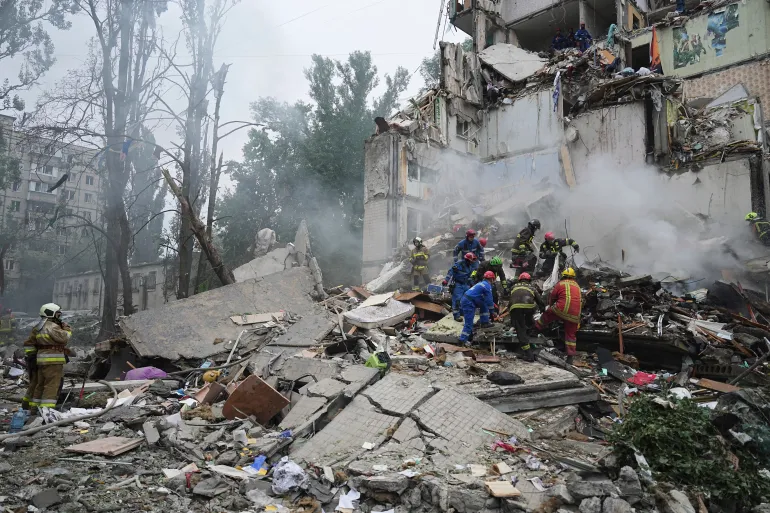
$361 Million in Minutes: The Enormous Cost of Russia’s Latest Missile Barrage
In an alarming snapshot of the war’s financial and human toll, experts estimate that a single recent strike by Russian forces cost roughly US $361 million in munitions deployed in just a matter of hours. (RBC Ukraine)
That figure reflects only the cost of the weapons used — not the human suffering, damage to infrastructure, long-term economic impact, or cost of rebuilding.
What was fired — and why the cost is so high
According to the breakdown from the strike, the barrage reportedly involved:
- 653 “kamikaze” drones — valued at approximately $15.5 million (RBC Ukraine)
- 3 hypersonic missiles (of the type known as “Kinzhal”) — around $36 million (RBC Ukraine)
- 34 cruise missiles — estimated at about $254 million (RBC Ukraine)
- 14 ballistic missiles (Iskander-M) — roughly $56 million (RBC Ukraine)
Combined, the delivery of these weapons in a single wave conveys how modern conflict — even in 2025 — demands staggering financial resources for just one assault.
Why the number matters — beyond the battlefield
Analysts emphasise that such a headline-grabbing cost carries deeper implications for Ukraine and for the wider global community:
- Rapid depletion of resources: Every $361 million salvo represents resources diverted toward destruction rather than construction, public services, or economic stability.
- Mounting human and infrastructure cost: Weapons are only half the story — damage to housing, schools, power-grids, hospitals, and transport infrastructure multiplies the human and economic cost many-fold.
- Rebuilding burden: With repeated strikes across multiple regions, reconstruction costs mount massively, slowing economic recovery and eroding living conditions for civilians.
- Strain on external support: As Ukraine continues to rely on international military and humanitarian aid, donors and governments face a grim calculus: the scale of destruction may outpace their capacity to help.
What this says about the war — and the long haul ahead
The estimate of $361 million for a single attack underlines a broader, harsh reality: the war is not just a sequence of battles — it is a vast economic drain.
From Ukraine’s standpoint, each night of aerial bombardment compounds the challenge of defending territory, protecting civilians, and preserving stability. Rebuilding just one damaged city or region could cost decades’ worth of national infrastructure investment.
For Russia, meanwhile, the cost to continue such heavy bombardments is similarly high — though questions remain about sustainability, manufacturing rates, and whether Moscow can maintain this tempo indefinitely. Some analysts caution that Western and Ukrainian estimates may overstate the per-unit cost of Russian missiles and drones. (Responsible Statecraft) Still, even conservative figures show that the war’s economic burden is colossal.
The human price — what the number doesn’t capture
Behind the dollar signs lie human lives. Each missile or drone may destroy buildings, but also displace families, interrupt schooling and healthcare, cut off power and water, and leave psychological scars on communities. Entire generations may face the consequences of lost homes, shattered infrastructure, and uncertainty about the future.
And the real cost only becomes apparent over time — as communities struggle to rebuild, supply chains collapse, and social services are stretched thin.
What’s Next — Rebuilding, Support, and International Responsibility
- Sustained humanitarian and reconstruction aid will be vital. The world must recognise that stopping bombs is only the first step; rebuilding Ukraine — in housing, energy, transport, and human welfare — demands long-term commitment.
- Continued monitoring of spending and support flows. Transparency on how military and civilian aid is used will matter more than ever, to avoid waste, corruption, and ensure effective relief.
- Diplomatic pressure and ceasefire efforts. As the costs — human, financial and environmental — wheel higher, international actors will face growing pressure to broker lasting peace.
- Support for resilience and civil infrastructure in Ukraine. Protection of critical services: power, water, hospitals, transport — should be a priority alongside defence.
The Bottom Line
That $361 million figure is not just a cost — it’s a wake-up call. It shows how destructive and costly war remains, even in modern times, and that the damage is more than military: it is social, economic, generational.
As the conflict grinds on, each strike sends a ripple far beyond fire and rubble — and the world’s response now will shape whether Ukraine emerges only as a battlefield or as a nation committed to rebuilding, recovery, and hope.
- International Puzzle Day: How Solving Problems Brings People Together
- Sir Cliff Richard Shares Cancer Diagnosis and Sends Message to King Charles
- The Great Divide: How Boomers and Millennials See Britain Totally Differently
- King Charles Faces Potential Mansion Tax Bill on His Private Homes
- Why Americans Think Brits Are Polite