How Russia’s “War Economy” Turns the Dead into a Grim Financial Engine
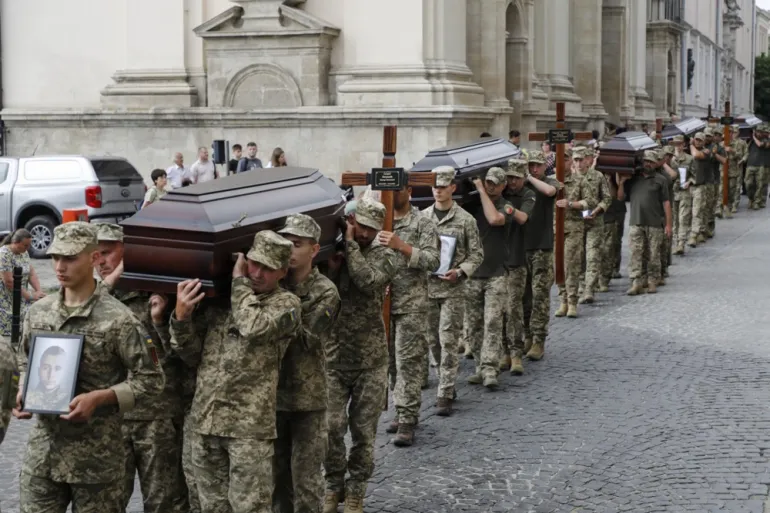
Recent analysis suggests that the heavy human toll for Vladimir Putin’s war in Ukraine — the mounting deaths and injuries of Russian soldiers — is being perversely leveraged to stimulate segments of Russia’s economy. What critics call an “economy of death” has become a cornerstone of Moscow’s war-time strategy: generating short-term growth while burying deep social and economic costs.
High incentives, deep casualties
To sustain its war effort — despite heavy sanctions and battlefield setbacks — Russia has dramatically increased pay, bonuses, and death-benefits for soldiers and their families. Under wartime contract terms, many volunteers earn several times the average civilian wage; some receive large signing bonuses and promises of substantial compensation if killed or wounded. (RadioFreeEurope/RadioLiberty)
- In some poorer regions, a death benefit for a fallen soldier can amount to more than what an average male might have earned working for decades in civilian life.
- For families devastated by loss, the government payout may appear financially attractive compared with uncertain civilian prospects — a grim incentive that has helped maintain enlistment levels.
- Economists call this perverse logic “death-onomics”: a system where dying on the battlefield is framed — implicitly, or explicitly — as more economically beneficial than remaining alive in many Russian regions. (Fortune)
This model has helped prop up nominal GDP growth in recent quarters, despite massive international sanctions. Russia’s state-driven military and defense-industrial sectors have expanded rapidly, absorbing much of the wartime spending and labour shift away from civilian industries.
Winners and losers — a stark class and regional divide
The benefits of this war-driven economy have not been evenly distributed. Instead, they disproportionately accrue to a narrow slice of society — especially poorer, rural or economically depressed regions that supply the majority of recruits. (therussiaprogram.org)
- Regions that send many soldiers have seen local incomes and financial flows spike — mortgages, consumer spending and certain economic indicators show improvement. (therussiaprogram.org)
- Meanwhile, wealthier, urban or “metropolitan” areas — often more critical of the war — face labour shortages, brain-drain, declining private sector activity, and broader economic stagnation. (therussiaprogram.org)
- Civilians outside the military-industrial loop suffer most: inflation, shortages, loss of workforce and heavy demographic impact as hundreds of thousands of young men have died or been wounded. (The Guardian)
In effect, the war has deepened Russia’s internal inequalities — turning soldiers into a de facto “new elite” while civilian industries and public services erode.
Societal and economic consequences — long-term damage under the surface
Although Russia’s wartime spending and militarised industries may produce short-term gains, analysts warn the model is unsustainable — and socially destructive. (War on the Rocks)
- The casualty toll is staggering: Western estimates suggest Russian military deaths and injuries since 2022 are among the highest in modern history. (The Guardian)
- Supporting returning wounded — many missing limbs or requiring lifelong care — places heavy strain on public health and social systems, already weakened by sanctions and economic decline. (War on the Rocks)
- Civilian labour shortages across many sectors, combined with brain-drain of professionals fleeing the country, undermine Russia’s long-term economic resilience and innovation capacity. (therussiaprogram.org)
- The psychological and demographic impact — with many families losing breadwinners, entire communities decimated — will leave scars that monetary compensation cannot heal. (The Guardian)
Why the Kremlin embraces the calculus — and what that says about the war
From the Kremlin’s perspective, the “deathonomics” strategy serves multiple purposes: it ensures a steady supply of soldiers, sustains economic activity despite sanctions, and binds poorer regions more tightly to the war effort through financial dependency.
Moreover, by positioning fallen soldiers and their families as temporary winners — with enhanced status, compensation, and social benefits — the government fosters a climate where sacrifice becomes normalized, and dissent marginalized.
Observers warn: this model treats human life as fungible — undermines social cohesion — and may temporarily mask but ultimately deepens Russia’s economic and demographic decline. (War on the Rocks)
The bottom line — a grim prosperity built on death
What may appear on paper as economic growth, increased incomes, and better odds for some families is — in reality — a deeply destructive bargain: a war-driven economy built on the backs of the dead and wounded.
For Russia, “growth” comes at the price of demographic collapse, social dislocation, labour shortages, and long-term structural weakening. For European observers — and the world — it highlights how war distorts economic incentives and corrodes societies.
As analysts put it: in Russia today, death pays — and that makes the war not just a military conflict, but an economic machine with human lives as fuel.
- International Puzzle Day: How Solving Problems Brings People Together
- Sir Cliff Richard Shares Cancer Diagnosis and Sends Message to King Charles
- The Great Divide: How Boomers and Millennials See Britain Totally Differently
- King Charles Faces Potential Mansion Tax Bill on His Private Homes
- Why Americans Think Brits Are Polite