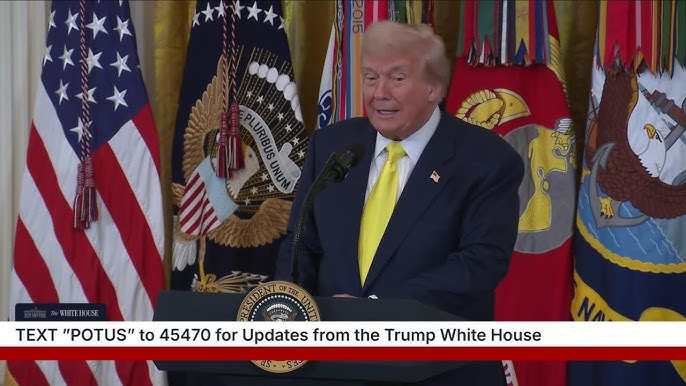
Trump Acknowledges His Clock Is Ticking — “Little More Than Three Years Left” in Office
Speaking to reporters recently, President Trump acknowledged that the remainder of his current term amounts to “a little more than three years,” a remark that comes amid growing speculation over his political ambitions and the limitations imposed by the U.S. Constitution.
After being inaugurated for his second (non-consecutive) term on 20 January 2025, Trump is set to finish this latest presidency in January 2029 — a period that his comment loosely tracks. (Wikipedia)
Why the Admission Matters — Constitutional Limits and Political Signalling
Under the Twenty‑Second Amendment to the United States Constitution, no person may be elected president more than twice. (constitution.congress.gov) Because Trump has already served one full term (2017-2021) and is now in his second, that constitutional guardrail means that — barring dramatic constitutional change — this will almost certainly be his final term. (The Guardian)
Yet for months Trump and some of his allies have flirted with the idea of remaining in power beyond 2029, provoking debate among constitutional scholars, politicians and the public. (Al Jazeera)
By explicitly acknowledging the limited timeline — “little more than three years left in office” — Trump may be offering a signal to supporters and critics alike. On one hand, it reflects realism about constitutional constraints. On the other, it forces the question of what he intends to accomplish before his time ends: and what legacy he hopes to leave.
What It Means for Policy, Politics — and Trump’s Next Moves
With fewer than four years remaining, much of the focus is shifting from ambition to execution. For the White House and Trump’s base, the next three-plus years will likely be framed as a final window to deliver on campaign promises, key legislative goals, and broader political objectives.
At the same time, critics argue that a presidency running against a fixed endpoint could face new challenges: legislative gridlock, waning influence abroad, or internal instability — especially if allies and partners question the long-term consistency of U.S. leadership.
Trump’s remark also renews attention on what comes after 2029. While his past hints at a third term — including circulating “Trump 2028” merchandise — generated controversy, constitutional experts stress such a candidacy would be blocked by the 22nd Amendment. (Al Jazeera)
Nevertheless, some of his supporters continue to mull hypothetical ways around the limit, such as constitutional amendment or creative legal manoeuvres — though most scholars consider them highly unlikely. (Reuters)
Why Many See 2026–2028 As a Critical Window
In practical terms, Trump’s acknowledgement underlines the urgency of the next few years. It sets expectations for policy outputs, clarifies the stakes for mid-term and congressional elections, and frames his presidency in finite terms.
For voters, allies and political rivals — both in the U.S. and abroad — it is a reminder that time is running out. What unfolds now will shape not only the final arc of his presidency, but how history judges it.
- International Puzzle Day: How Solving Problems Brings People Together
- Sir Cliff Richard Shares Cancer Diagnosis and Sends Message to King Charles
- The Great Divide: How Boomers and Millennials See Britain Totally Differently
- King Charles Faces Potential Mansion Tax Bill on His Private Homes
- Why Americans Think Brits Are Polite